
The Efficiency Plateau: Why Your Nonprofit's AI Strategy is Stuck in Draft Mode
- Alyson Long
- 6 days ago
- 3 min read

If your nonprofit or ministry is like 92% of the social sector, you are already using artificial intelligence. You are likely using it to draft newsletters, summarize long grant requirements, or generate meeting agendas.
But if you are also part of that majority, you probably haven't seen a structural transformation in how your organization actually operates. In fact, recent data reveals that only 7% of nonprofits report that AI has significantly expanded their operational capacity.
We call this the Efficiency Plateau.
You are using technology to do the exact same manual tasks, just slightly faster. While saving a few minutes on an email is helpful, it is not enough to combat the 46% burnout rate currently plaguing nonprofit leadership. True scale and sustainability require moving beyond basic prompts. It requires a structural transition from Generative AI to Agentic AI.
The Generative Trap: A Faster Typewriter
To understand the plateau, we have to look at how most organizations are currently deploying technology.
Generative AI (like basic, public chatbots) is a passive tool. It requires a human to constantly prompt it, copy the output, verify it, and paste it into a separate workflow. It solves a drafting problem, not a capacity problem.
The Reality: If your staff is still manually copying a generated email, opening a CRM, finding the donor profile, pasting the text, and logging the interaction, your AI is stuck in draft mode. It is acting as a fancy typewriter, not an operational solution.
The Agentic Shift: From Tool to Teammate
To break through the efficiency plateau, the sector must transition to Agentic AI.
Unlike a passive text generator, Agentic AI operates as an autonomous teammate. A specialized agent perceives its environment, plans multi-step workflows, connects directly to your databases via APIs, and executes tasks independently.
Let's look at a real-world volunteer management scenario: A volunteer cancels a shift at 10:00 PM.
The Generative AI Workflow: The next morning, a stressed volunteer coordinator prompts a chatbot to write a polite email asking for a replacement. The coordinator copies the text, opens their spreadsheet, finds the waitlist, pastes the email, and waits for replies.
The Agentic AI Workflow: An autonomous agent detects the cancellation in your system the moment it happens. It autonomously texts the next three people on the waitlist, verifies the new volunteer's liability waiver, and seamlessly updates your Salesforce dashboard—all while your staff is asleep.
Agentic AI doesn't just write the message; it manages the full operational lifecycle of the task.

Bridging the Data-Readiness Gap Safely
Advanced automation sounds incredible, but it introduces a critical hurdle: Data Sovereignty.
Agentic AI cannot function on fragmented spreadsheets and disorganized shared drives. More importantly, uploading sensitive beneficiary records or donor lists into unapproved, public AI models creates severe "Shadow AI" liabilities and privacy breaches. We cannot sacrifice data equity for operational speed.
To achieve true capacity safely, organizations must utilize Retrieval-Augmented Generation (RAG) in sandboxed environments.
What is a Sandboxed RAG Environment?
Zero-Hallucination Execution: The AI's "brain" is constrained exclusively to your approved, internal documents (like past Form 990s, official policy manuals, and verified website copy). It cannot fabricate metrics or guess answers.
Total Data Isolation: Your community's data is never uploaded to public models or used to train external algorithms.
Community Trust: By setting transparent guardrails, you ensure that marginalized or vulnerable populations are protected by design.
Protecting Joy Capital: Reclaiming the 15-Hour Shift
The ultimate goal of upgrading from Generative to Agentic AI is not to shrink your headcount or eliminate human jobs. The goal is to maximize your Return on Mission (ROM).
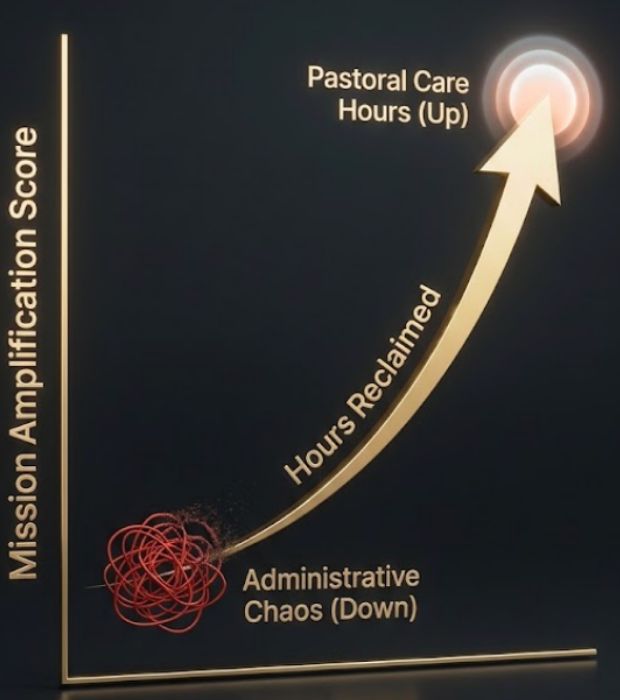
When you offload the heavy logistical burdens—the 24/7 FAQ answering, the intake sorting, the volunteer scheduling, and the database syncing—to a secure digital teammate, you can structurally hand 10 to 20 hours back to your frontline staff every single week.
We call this protecting your organization's Joy Capital.
Passionate caseworkers, pastors, and development directors did not enter the social sector to manage software subscriptions or untangle spreadsheets. They entered this work to heal communities and change lives.
Technology should not replace human connection. It should remove the administrative noise so human connection can actually happen. It is time to stop using AI to write emails faster, and start using it to reclaim your hours, scale your mission, and protect your people.


Comments